Myopia - The Long Problem
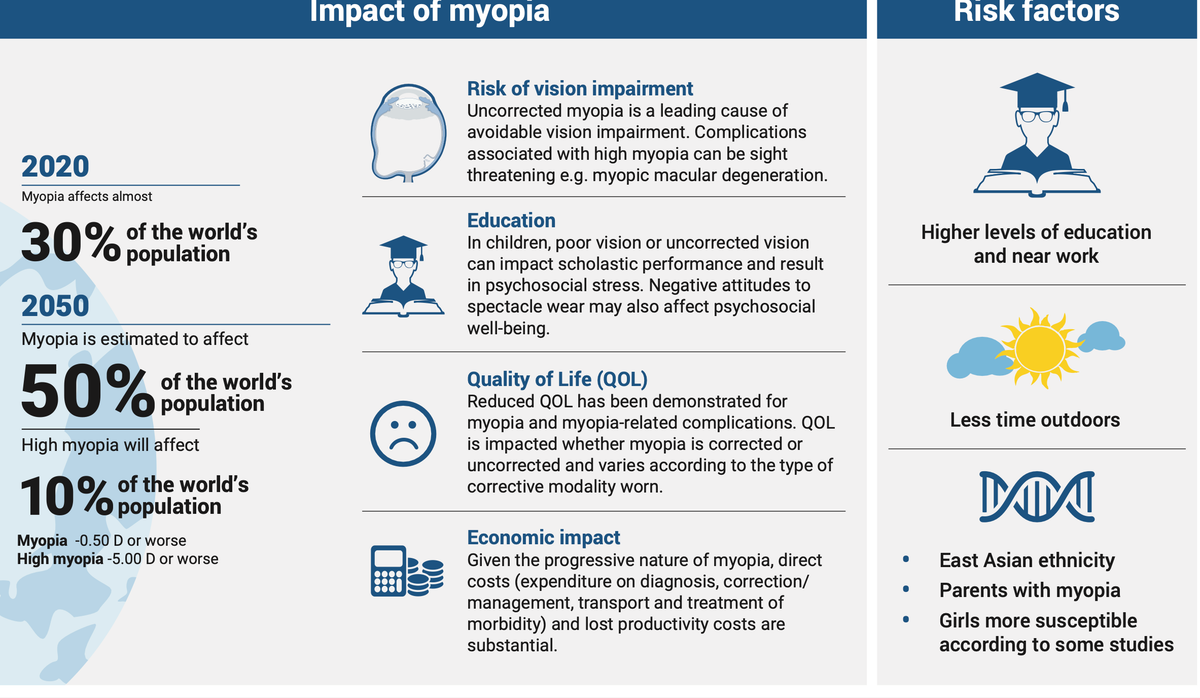
Reading may be bad for you. Most close-up, text-heavy, first-world white collar service work may be bad for you.
Strong claims, and they do come with caveats, such as "if you're already genetically or otherwise predisposed to nearsightedness". Myopia, or nearsightedness is a condition where the eye is too long, changing the point where images focus in the eye.
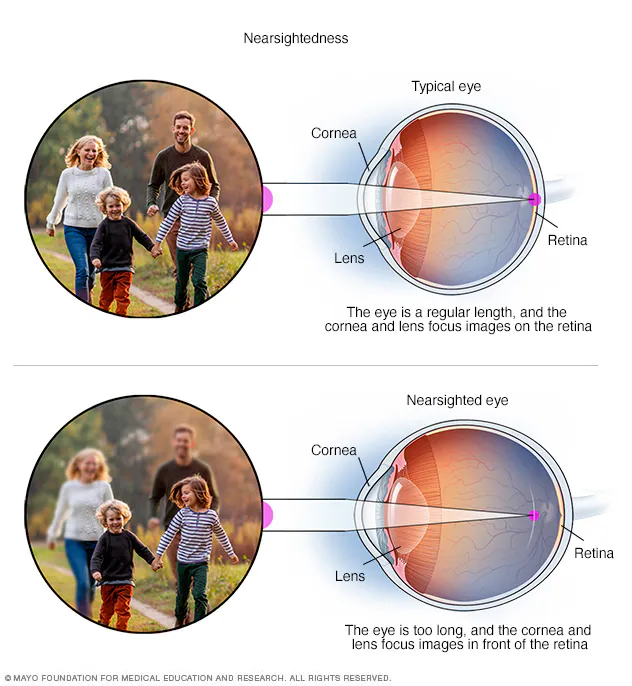
Mayo clinic diagram, representing very slight, mild myopia.
Myopia was thought to be mostly harmless for a long time. It was thought to be solely caused by genetics for a long time. It was also thought to stop getting worse around age 12 (I've had an ophthalmologist tell me this was her belief). Research from the last few decades, and a recent surge in the last decade of enthusiastic optometrists reconsidering has shown that each of these once commonly-held beliefs are false and harmful.
[!warning] What follows is based on my own experience and layperson's interpretation. Any information should be verified with a trusted eyecare professional
the problem
There's growing awareness that this is a problem. A large problem. Epidemic-level even. A piece in 2022 By Sarah Zhang highlighted awareness of the problem for at least those in the upper-class readership of the Atlantic:
"Nearsighted eyes become prone to serious problems like glaucoma and retinal detachment in middle age, conditions that can in turn cause permanent blindness. The risks start small but rise exponentially with higher prescriptions. The younger myopia starts, the worse the outlook. In 2019, the American Academy of Ophthalmology convened a task force to recognize myopia as an urgent global-health problem. As Michael Repka, an ophthalmology professor at Johns Hopkins University and the AAO’s medical director for government affairs, told me, “You’re trying to head off an epidemic of blindness that’s decades down the road.”"
In the nearer term, with respect to high myopia (even longer eyes and even stronger correction): "Studies have shown that high myopia impairs QOL to an extent comparable to keratoconus, an ocular condition traditionally associated with significant disability. 35 Factors such as dependency on optical correction, limitations in recreational activities, reduced self-esteem and financial burden related to care contribute to this diminished QOL. " (source) From personal experience, several of these items resonate.
Here are a few charts that show the alarming rise of myopia in the past century in Asia and Europe. The pattern also holds for North America.
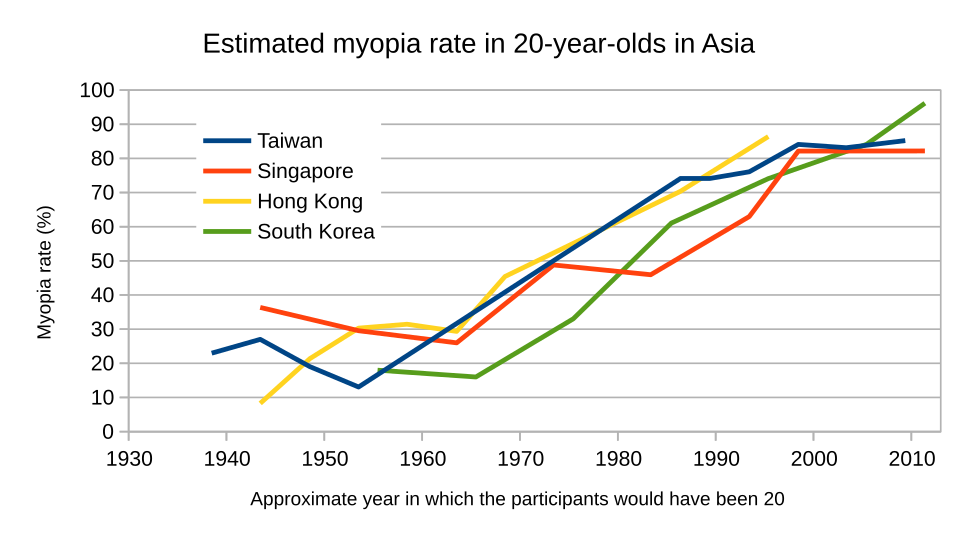
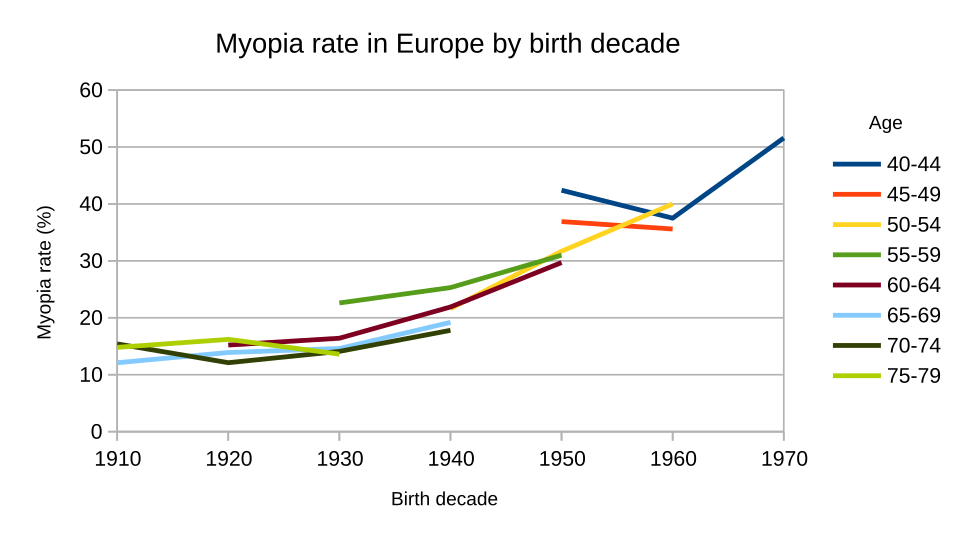
source: wikipedia
This is the first in a series where I'm going to talk about what I've learned about this disorder after deciding to take it seriously after about 3 decades of living with it. And I'll share some of my personal experiences with myopia, and about the thankfully expanding field of people who are trying to do something about it. And no, prescribing regular eyeglasses is no longer sufficient when it comes to doing something about it.
First I'll go more into detail about the problems and risks associated with myopia. Then, I'll talk about some of the hypotheses that have been offered for its causes (it's not solely genetic!) After that I'll share some of my personal experiences in finding practitioners that recognize the issue and are willing to do something about it, with the distinctive perspective of an adult seeking help in an area where clinical trials have only been done in children. After that I'll provide a summary of some of the possible and emerging treatments I've become aware of (again, most are only tested in kids!) And finally I'll review all of that and offer some resources for those who want to dig even deeper.
Please be aware - I'm not an eye care professional. There are resources offered later, in the last part that may help you in finding folks who are willing to check in with you on anything I'm sharing here. And even then, because of the newness of the field of myopia management, and the relative lack of data, even professionals sometimes have to do some educated guessing sometimes.
Full International Myopia Institute infographic from header found here